Wednesday, April 22, 2015

Are cavities contagious?

Yes! Tooth decay is indeed contagious. Because there is bacteria in the tooth decay, it can be passed between people, similar to a bad cold.

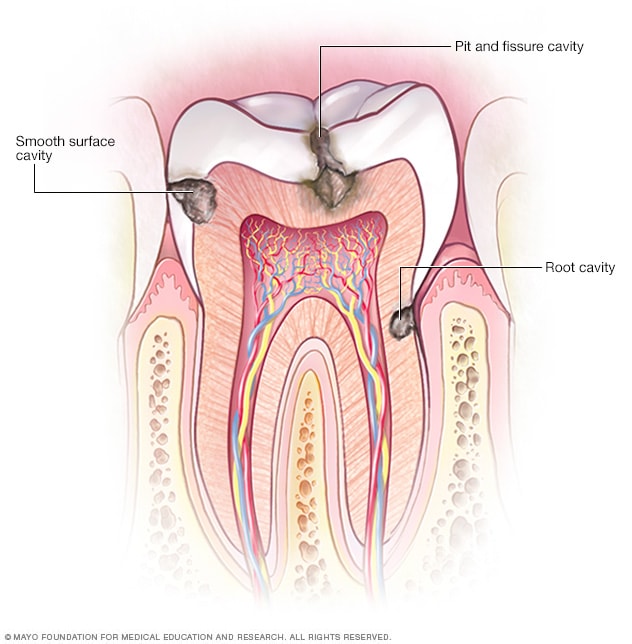
Sugar is a big culprit for causing cavities, but they're also caused by certain types of bacteria. These bacterias release acids that break down the hard enamel on the outside of the teeth causing holes, better known as cavities. This bacteria can easily be passed by kissing, sharing food or even sharing silverware.

Another interesting fact, children are not just born with cavities. More often than not, cavities are passed to them from their parents or care givers. As long as the mom or dad have good oral health, their children should have good oral health too.

There are ways to avoid passing cavities from one to another, for example, if you drop a pacifier, do not put it in your mouth to clean it off and then place it in your child's mouth. Rather go to a restroom to clean it. A few more ways include avoiding sharing utensils, avoid kissing baby's lips, not sharing tooth brushes or even avoid pre-chewing food for youngsters if you do not have proper utensils to prepare it.

The best way to avoid cavities is by practicing good oral health. Brushing and flossing at least two times a day, and if you eat more acidic food adding an extra brushing afterward wouldn't hurt. Keep these tips in mind to help your children practice good oral health too!

Thursday, April 16, 2015

FREE DENTISTRY AT GLACIER DENTAL

Dentistry from the Heart will 

take place NEXT FRIDAY!

The event starts at 7 a.m. and is first come first serve.

{Patients can choose from a filling, extraction or cleaning}

Anyone and everyone are welcome to attend!

Light drinks and snacks will be provided, courtesy of local businesses!!

Thank you to everyone who donated:

® Fratellos Waterfront Restaurant & Brewery ® Marty in the Morning from B104.7 ® Steinert Printing ® Culligan ® Henry Schein®Delta Dental ® CareCredit ® Patterson Dental ® Ultradent ®Buffalo Wild Wings ® Colgate ® Hu-Friedy ® Starbucks ® Advance Disposal ® Planet Perk  ® Piggly Wiggly ® The Blanchard Family ® Erbert and Gerberts
® Toppers Pizza ®  4 imprint ®   Green Bay Gamblers ®

Wednesday, April 8, 2015

Free Dentistry at Glacier Dental

Glacier Dental will be partaking in
Dentistry from the Heart
on Friday, April 24, 2015 from 7 a.m. - 5 p.m.

What does this mean for you?

FREE DENTISTRY!

It is based on a first come first serve basis. 
Each patient can choose either a free filling, free extraction or free cleaning!

Marty in the Morning from B107.4 will be making an appearance to the event,
and several restaurants in the area will be donating food and drinks for anyone standing in line! The Community Blood Center will also have a bus for anyone interested in paying it forward and wanting to donate blood!

We hope to serve more than 200 patients this year, so tell your family and friends!!


We are very thankful for all of our sponsors including:

® Fratellos Waterfront Restaurant & Brewery ® Marty in the Morning from B104.7 ® Steinert Printing ® Culligan ® Henry Schein®Delta Dental ® CareCredit ® Patterson Dental ® Ultradent ®Buffalo Wild Wings ® Colgate ® Hu-Friedy ® Starbucks ® Advance Disposal ® Planet Perk  ® Piggly Wiggly ® The Blanchard Family ® Erbert and Gerberts
® Toppers Pizza ®  4 imprint ®   Green Bay Gamblers ®


Wednesday, April 1, 2015

Sensitive tooth after treatment?

Sometimes patients have sensitivity after having a filling or a crown done and we want you to know this is normal. Once the treatment is completed,the patient is asked if everything feels normal. Since patients are typically numb, it can be hard to tell if the bite feels normal or natural. To help combat this the Doctor always uses a bite marking piece of paper to be sure your bite is normal. However, sometimes it takes for the numbing to wear off before the patient notices it doesn't feel right and they're having sensitivity in that area. This means the patient needs to come back for an adjustment on that tooth to make sure the filling isn't too high, causing aching.

If several adjustments are made and the tooth is still causing sensitivity there may be something else going on with the tooth. Sometimes if a really large filling was placed, the tooth may actually need a crown. If a crown was placed, an x-ray may need to be taken to make sure the tooth is healthy. If the tooth is not healthy, it may need a root canal. Prior to recommending a root canal, Glacier Dental will try/recommend other options to help with the sensitivity.

If you are experiencing tooth sensitivity after an appointment, please do not hesitate to call our office at 920-235-3251 for a free adjustment appointment. We want to be sure you are as comfortable as possible!

Wednesday, March 25, 2015

Why Glacier Dental recommends sealants!

Sealants are often recommended to young children to help prevent cavities. A sealant is a plastic material used to cover the surface of a tooth to help fill in the grooves. They are considered preventative care because the plastic seal prevents food from getting stuck in deep grooves and causing cavities. The reason they are more often recommended to children is to help protect their teeth right away.

However, sealants are also highly recommended for adults who do not have them on their molars. If you're prone to getting cavities, sealants are a great way to help reduce that risk.  The biggest downfall to getting sealants later on in life, is the fact that insurances typically will not cover them if you are over the age of 14, but they are an inexpensive procedure. It is more cost effective to seal your teeth now, than pay for a filling down the road.

Sealants are a pain-free procedure and are applied to the teeth very quickly. Below is an image of how the Doctor or hygienist applies the sealant.


Once the sealant is placed, it can usually last for a few years, some people several years. It is important to remember, however, sealants do not stop teeth from decaying, it helps prevent decay. It is still very important to brush two times a day and floss at least once a day. Next time you're in, ask the Doctor or Hygienist if you have any teeth that they would recommend a sealant on, your teeth are worth it!

Wednesday, March 18, 2015

Are E-Cigarettes better for your smile?


To start out, e-cigarettes still contain nicotine, which we all know isn't good for our overall health. But what exactly does the nicotine do? It restricts blood vessels and increases risk for periodontal disease. 

What does all that jargon mean? Everyone has white blood cells that "eat bacteria" and reduce the bad bacterial levels (which is a very good thing!). If blood vessels are restricted, causing less blood flow, these white blood cells are unable to do their job of reducing bad bacteria. As a result, gingivitis may occur which can lead to a more progressed inflammation and redness of gums, also known as periodontal disease. According to National Institute of Dental and Craniofacial Research." In periodontitis, gums pull away from the teeth and form spaces (called “pockets”) that become infected." If not treated, teeth may become loose and fall out. 

If you're curious as to whether or not it's worth switching to e-cigs from regular cigarettes, the answer may not be clear. There hasn't been enough research to say whether or not it's much healthier, but here are a few facts. 

E-cigs do not has as much of an effect on recovery processes as opposed to regular cigarettes, however they still do have some effect. According to WebMD, "The biggest danger from tobacco is the smoke, and e-cigarettes don't burn. Tests show the levels of dangerous chemicals they give off are a fraction of what you'd get from a real cigarette." 

Although e-cigarettes are not as "harsh" as regular cigarettes, they can still be harmful to your body and your smile, so use them as a "bridge" to help you quit, if you plan to quit eventually, but we wouldn't recommend just switching to them as an alternative or starting to use them for "fun" if you're not a smoker already.

Wednesday, March 11, 2015

What's better electric tooth brush or manual?

There truly is no correct answer to what is better, an electric toothbrush or a manual, simply because if you don't use it, it won't work. According to the Academy of General Dentistry, "The best toothbrush is the one you will actually use." But let's explore the pros and cons of each, and maybe it will help you decide what's best for you!

Of course the Phillips Sonicare DiamondClean toothbrush is excellent, several of Glacier Dental's patients have purchased these and absolutely love them. There are five different brushing settings and each have their own benefits. Sonicare toothbrushes are proven to remove 7x more plaque than a manual toothbrush and can improve gum health in just two weeks. They're also used to whiten teeth in one week by removing surface stains. In addition, this automatic tooth brush has a built in timer and will shut off after two minutes (the proper brush time).

As nice and convenient electric tooth brushes they do have downfalls, just like everything else. The initial cost of an electric toothbrush can be pricey but the benefits of the toothbrush will definitely pay off! Also, you only have to pay that fee once, and the toothbrush heads are removable so more than one person can use the toothbrush. The other downfall is it does need to be charged, however, the DiamondClean can keep a full charge for over a week. It also can be charged with a wall plug-in or a USB plug-in for travel.

Now electric toothbrushes are great, but if you're not going to use it, it's useless. Manual toothbrushes also have many benefits. They're cost effective (especially if you get a free one at your six month check up!), they're easy for traveling, and they're easy for children. The problem is, two minutes of brush time is a lot easier to measure with an electric toothbrush than a manual. So brush time can be reduced by accident. Also, sometimes the toothbrush heads can be too big and proper brushing is not practiced. 

In all reality, whatever toothbrush you are actually going to use, is going to be the recommended one. An electric toothbrush (if you purchase the right one, Sonicare brand is highly recommended) will have more benefits over a manual toothbrush, simply because it can remove more plaque, but a manual toothbrush can get the job done too!